Anchor Bolts for Concrete: Types, Selection and Installation Checks
Choosing the right anchor bolts is essential when a project needs to secure steelwork, equipment, pipe supports, cable supports, handrails or other fixtures to concrete. The term covers several different fixing systems. A cast-in foundation bolt, a mechanical wedge anchor and a resin-bonded threaded rod do not transfer load in the same way, and they cannot be substituted for one another simply because their thread sizes look similar.
For civil contractors, structural fabricators, MEP installers, facility managers and procurement teams in Abu Dhabi and across the UAE, this guide explains the main anchor types, the information required for selection, installation checks and what to include in a request for quotation (RFQ). It is a procurement and planning guide, not a structural design calculation. The project engineer must specify the approved anchoring system for the actual loads and base material.
1. What are anchor bolts used for?
Anchors connect an item to a concrete or masonry base. Depending on the system and approved application, they may secure base plates, machinery, support frames, pipe brackets, cable containment, façade components, barriers, access equipment and building services.
Some anchors are installed while concrete is being poured. Others are installed later into drilled holes in hardened concrete. Post-installed products may work through mechanical expansion, screw engagement, an undercut or an adhesive bond. The fixing method, base material and design approval determine where each type can be used.
2. Common types of anchor bolts and concrete fixings
| Type | How it works | Typical application context | Key check |
|---|---|---|---|
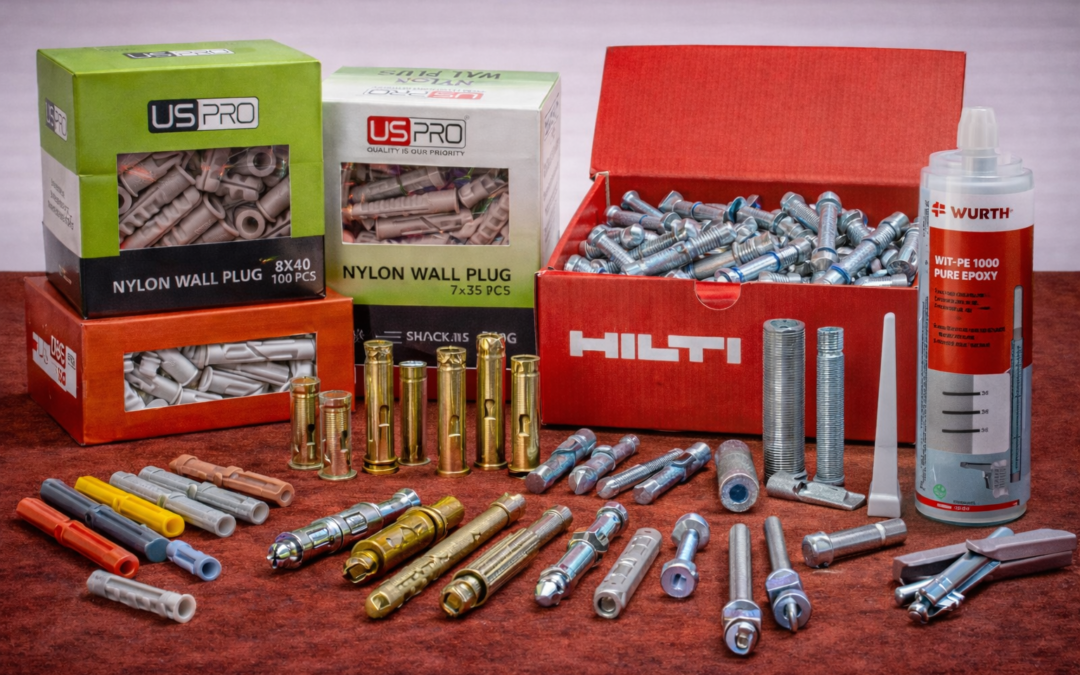
| Cast-in foundation bolts | Placed in the formwork before the concrete is poured and embedded as the concrete hardens | Steel columns, equipment base plates, foundations and planned structural connections | Template position, projection, embedment, alignment and reinforcement coordination |
| Wedge anchors | A mechanical expansion mechanism engages the sides of a drilled hole as the anchor is set | Approved fixings into suitable solid concrete, such as brackets, supports and base plates | Hole diameter, embedment, edge distance, spacing and installation torque |
| Sleeve or shield anchors | A sleeve expands against the sides of the drilled hole when tightened | Selected fixtures and brackets where the particular anchor is approved for the base material | Substrate suitability and the manufacturer’s load and installation data |
| Drop-in anchors | An internally threaded metal anchor is set inside a drilled hole to accept a bolt or threaded rod | Flush fixing points and suspended services such as selected MEP supports | Correct setting tool, hole depth, embedment and thread engagement |
| Chemical or adhesive anchors | A specified resin system bonds a threaded rod or reinforcing bar into a prepared hole | Designed post-installed connections where the selected system’s approvals and calculations permit it | Resin approval, hole cleaning, moisture condition, temperature and full curing time |
| Concrete screws | A purpose-designed thread engages the concrete in a pre-drilled hole | Specific light, medium or heavy-duty fixing applications covered by the product approval | Approved base material, hole preparation, embedment and installation method |
A nylon wall plug or light-duty fixing plug is a different product from a structural anchor. Ruby’s Hardware & Fasteners range lists anchor bolts, wedge anchors, sleeve anchors, chemical anchors with resin, drop-in anchors, expansion anchors, threaded rods, studs, nuts and washers. Confirm the exact product type and specification before ordering.
3. How to select the right anchor for a project
Identify the load and connection
The designer needs to understand whether the connection is subject to tension, shear or a combination of both. Machinery, moving equipment, vibrating services, suspended loads, impact, fatigue and seismic actions may introduce additional design requirements. Do not choose a bolt diameter by copying a nearby installation or using a generic online load chart.
Confirm the base material
Record whether the fixing is going into normal-weight concrete, lightweight concrete, solid masonry, hollow block or another substrate. For concrete, the specified compressive strength, member thickness and whether the concrete may be cracked are important. A wedge anchor approved for a particular concrete condition is not automatically suitable for hollow block, AAC or brick.
Before drilling, check drawings and use a suitable scanning method to locate reinforcement, post-tensioning tendons and embedded services where present. Drilling into reinforcement or a tendon can create a serious safety and structural problem. If the planned location conflicts with reinforcement, refer the issue to the responsible engineer rather than shifting the hole without approval.
Check edge distance, spacing and embedment
Anchor performance can be affected by the distance to a concrete edge, the spacing between anchors, member thickness, embedment depth and the position of nearby reinforcement. These are design inputs, not optional installation preferences. A fixing placed too close to an edge or another anchor can cause concrete breakout, splitting or other failure modes.
Consider corrosion and the site environment
The required steel grade and coating depend on exposure, service life, the connected material and the project specification. Dry indoor conditions, outdoor weather, coastal salt exposure, wash-down areas and chemical environments do not present the same corrosion risk. Zinc-plated, hot-dip galvanized and stainless-steel options are not interchangeable by appearance alone. Specify the required grade and finish and obtain confirmation for the intended environment.
Check approvals and design documentation
For structural or safety-related connections, the engineer should specify the anchor system and its qualification for the application. Relevant documents may include an ETA, ICC-ES evaluation report or other project-accepted technical approval. Check whether the report covers cracked or uncracked concrete, seismic conditions, fire exposure, sustained loading, the installation orientation and the actual base material.
The American Concrete Institute’s ACI 318-25 includes Chapter 17 on anchoring to concrete, including design provisions for tension, shear, combined loading, edge distances, spacing and earthquake-resistant anchor design. The ICC-ES approved acceptance criteria list AC193 for mechanical anchors and AC308 for post-installed adhesive anchors in concrete. The applicable project code and authority requirements must be confirmed by the design team.
4. Installation checks that should not be skipped
Even a correctly specified anchor can perform poorly if it is installed incorrectly. Use trained installers and the current instructions supplied for the exact product. A typical quality-control sequence includes the following checks, but the product’s instructions always take priority:
- Set out the fixing: verify the approved drawing, anchor locations, edge distances, spacing and clearance from reinforcement or embedded services.
- Drill the specified hole: use the stated diameter, depth, drill type and bit condition. Do not enlarge a hole or change the drilling method unless the approval allows it.
- Clean the hole as instructed: dust and drilling debris can affect the performance of bonded anchors and may also interfere with mechanical anchors. Use the specified brush, blow-out method or approved dust-extraction system. Do not assume that one cleaning sequence applies to every product.
- Install to the correct depth: use the required setting tool, embedment mark, insertion method and orientation. Keep the anchor aligned and avoid damaging threads.
- Apply the specified torque or cure time: mechanical anchors may require a stated installation torque. Adhesive anchors need the specified injection, rod insertion and curing procedure before loading. Temperature can affect working and curing time.
- Inspect and record: check the installed position, projection, washer and nut arrangement, torque records where required, batch information and any inspection hold points.
For adhesive anchors, the cartridge, mixer nozzle, resin temperature, hole condition and installation temperature can all matter. Some systems require initial material to be discarded until the two components are properly mixed. The rod is commonly inserted while rotating it as specified, and the connection must remain undisturbed until the stated cure time has elapsed. These details vary by product.
Hilti’s SafeSet installation guidance illustrates why hole cleaning and controlled adhesive dispensing are important for its systems. It is an example of manufacturer-specific guidance, not a universal installation procedure for every anchor brand.
5. Common anchor bolt procurement and installation mistakes
- Ordering only by thread diameter without stating anchor type, length, material and intended application.
- Substituting a wedge anchor for a chemical anchor, or vice versa, without design approval.
- Using an anchor in hollow block or masonry when its approval only covers concrete.
- Ignoring edge distance, anchor spacing, concrete thickness or reinforcement location.
- Assuming that every resin anchor is suitable for wet holes, cracked concrete or seismic conditions.
- Skipping hole cleaning, using a worn brush or using an unapproved drilling method.
- Applying load before an adhesive anchor has completed its product-specific cure period.
- Choosing a coating or stainless grade without considering the actual exposure and specification.
6. What to include in an anchor bolt RFQ or BOQ
A clear enquiry helps the supplier identify the correct product family and reduces the risk of an unsuitable substitution. Include the following details where available:
- Application and connection description, such as base plate, pipe support, machinery, handrail or suspended service.
- Anchor type or engineer-approved product specification.
- Nominal diameter, total length, thread size, embedment and projection requirements.
- Base material, concrete strength, member thickness and cracked or uncracked condition where specified.
- Required steel grade, coating or stainless-steel grade.
- Required approvals, technical data sheets, installation instructions and certificates.
- Quantity, nuts, washers, threaded rods, resin cartridges, mixing nozzles and setting tools required.
- Site location, delivery date, packaging and any project-specific inspection requirements.
Attach the relevant drawing, base-plate detail, BOQ or approved material submittal. If an equivalent is acceptable, define the performance and approval criteria that the alternative must meet. Do not ask a supplier to choose a structural anchor from a photograph alone.
7. Sourcing hardware and concrete fixings from Ruby General Trading
Ruby General Trading LLC’s published Hardware & Fasteners range in Musaffah lists anchor bolts, wedge anchors, sleeve anchors, chemical anchors with resin, drop-in anchors, expansion anchors, threaded rods in GI and stainless-steel options, studs, coupling nuts, bolts, nuts and washers. The exact model, grade, finish, approval, size and availability should be checked against the project requirement before an order is placed.
For wider project procurement, contractors can also review Ruby’s construction materials, adhesives and sealants and industrial hoses and fittings categories for related site and maintenance requirements.
Need anchor bolts or concrete fixings for a project? Send Ruby your BOQ, drawing, preferred brand, technical specification and required quantities for a quotation review. Contact the team through the Ruby contact page, email info@rubytrdg.com or call +971 50 138 7277. Ruby’s listed Abu Dhabi address is near Nesto, Musaffah 26, Abu Dhabi, UAE.
Frequently Asked Questions
What is the difference between an anchor bolt and a concrete anchor?
Anchor bolt is often used broadly for a threaded fixing that connects an item to concrete. Concrete anchors include several product families, such as wedge, sleeve, drop-in, screw and adhesive anchors. The exact product type should be stated in the specification.
Are chemical anchors stronger than wedge anchors?
There is no universal answer. Capacity depends on the exact anchor system, concrete condition, embedment, edge distance, spacing, installation and design loads. Compare approved technical data and have the connection checked by the responsible engineer.
Can chemical anchors be used in cracked concrete?
Only when the exact adhesive anchor system has the required qualification for cracked concrete and the design meets the relevant code and approval conditions. Do not infer cracked-concrete suitability from the word epoxy or chemical on the cartridge.
Can I use wedge anchors in hollow blocks?
Do not assume so. A wedge anchor intended for solid concrete may not be suitable for hollow masonry. Select a fixing specifically approved for the actual block or masonry construction and the intended load.
Why is hole cleaning important for chemical anchors?
Dust and drilling residue can interfere with the bond between the adhesive and the hole wall. Follow the exact manufacturer’s cleaning method, including the specified brush size, air source or approved dust-extraction system.
Which anchor finish is suitable for coastal projects in the UAE?
The required finish depends on the exposure category, expected service life, connected materials and project specification. Stainless steel or a specified protective coating may be required, but the grade must be selected for the environment rather than assumed from appearance.
What details should I send when requesting an anchor bolt quotation?
Send the application, anchor type, dimensions, material and finish, base material, approved specification, quantity, required accessories, technical documents and delivery location. A drawing or BOQ helps the supplier review the requirement more accurately.