Chemical Resistant Gloves: How to Choose the Right Material for Industrial Work
Selecting the right chemical resistant gloves is a task-specific safety decision, not simply a choice between nitrile, latex or rubber. The glove must match the exact substance, its concentration and temperature, the way it contacts the hand, and how long the worker may be exposed. A glove that performs well with one cleaning chemical may fail quickly when used with a different solvent or a concentrated process chemical.
For HSE managers, procurement teams, facility managers, maintenance contractors, paint applicators, workshop supervisors and industrial operators in Abu Dhabi and across the UAE, this guide explains how to assess chemical hazards, compare common glove materials, read performance information and prepare a clear request for quotation (RFQ). It is a buying guide, not a substitute for a site risk assessment or the glove manufacturer’s chemical-resistance data.
1. Start with the chemical and the task, not the glove colour
Before choosing a glove, identify the actual product being handled. Trade names such as degreaser, thinner, descaler, paint remover, detergent or hydraulic cleaner are not precise enough on their own. Different formulations can contain different solvents, additives and concentrations.
Ask the site team for the current Safety Data Sheet (SDS) and identify the chemical name, mixture ingredients where disclosed, concentration, temperature and relevant hazard statements. The SDS section on exposure controls and personal protection is a useful starting point, but it does not replace a glove-specific compatibility assessment.
- Substance: record the exact product name, chemical name and CAS number where available
- Concentration: note whether the material is diluted, concentrated or a mixture
- Temperature: chemical resistance can change as temperature rises
- Contact: distinguish an occasional splash from repeated wet contact or full immersion
- Duration: record how long each task lasts and how often it is repeated
- Other hazards: identify sharp edges, abrasion, heat, puncture risk and grip requirements
2. Compare common chemical glove materials
Glove materials have different strengths, but no single polymer protects against every chemical. The descriptions below are general screening guidance only. The exact formulation, thickness, lining, construction and manufacturer’s test results determine whether a particular glove is suitable.
| Material / construction | Typical selection context | Important caution |
|---|---|---|
| Nitrile | Often considered for oils, greases and a range of industrial chemicals; available in disposable and reusable constructions | Not universal. Some ketones, aromatic solvents and other chemicals can be unsuitable for particular nitrile formulations |
| PVC | May be suitable for selected aqueous acids, alkalis, salts and wet handling tasks | Compatibility varies by chemical and formulation; flexibility and dexterity can change with temperature |
| Natural rubber / latex | Can be considered for selected water-based chemicals and cleaning applications | Not suitable for every solvent; natural latex can cause sensitisation or allergic reactions in some users |
| Neoprene | Used in some reusable chemical-protection applications where a broad material profile is required | Check the exact chemical, concentration, temperature and model test data |
| Butyl rubber | A specialist option considered for certain aggressive chemicals and solvent families | It is not a universal barrier; obtain chemical-specific permeation and degradation information |
| Vinyl / light disposable gloves | May suit low-risk, short-duration hygiene or handling tasks where the product specification allows | Do not assume a general disposable glove is suitable for industrial chemical exposure |
| Coated knitted gloves | Useful for grip, abrasion and general handling when the coating and task are matched | A nitrile-coated palm or dotted glove is not automatically a full chemical-protection glove |
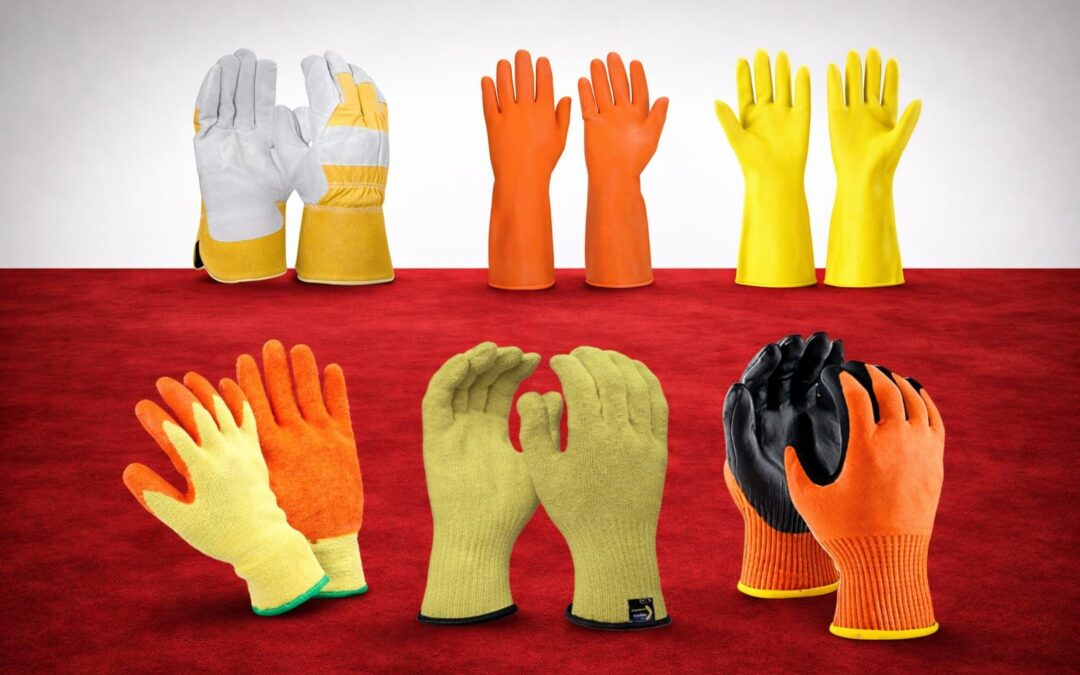
Ruby’s Safety Equipment and PPE range lists chemical-resistant gloves as well as nitrile, latex, vinyl, rubber, cotton, leather, heat-resistant, cut-resistant, electrical-insulated and welding gloves. These are different product types for different hazards. Confirm the exact material, construction, length, standard and model available for your application rather than assuming that every glove in a material family has the same performance.
3. Understand penetration, permeation and degradation
A glove can appear intact and still be unsuitable for a chemical task. Three different failure mechanisms matter when evaluating chemical protection:
- Penetration: liquid or particles pass through holes, seams, pinholes or defects in the glove material
- Permeation: chemical molecules pass through the glove material at a molecular level, even when no visible hole is present
- Degradation: chemical contact changes the glove’s physical properties, for example by swelling, softening, hardening, cracking or losing strength
A manufacturer’s permeation test may report a breakthrough time under defined laboratory conditions. That value is useful for comparing products, but it is not a guaranteed safe wearing period or a universal change-out interval. Actual performance can be affected by temperature, concentration, mixtures, glove thickness, flexing, wear and the way the chemical contacts the glove.
For mixtures or formulated products, do not select a glove by checking only one familiar ingredient. Ask the manufacturer or technical supplier to assess the complete formulation where possible. If compatibility information is unclear, stop and obtain a competent assessment rather than relying on a generic material chart.
4. Check the standard, test evidence and product label
For chemical protective gloves, ask whether the exact model has been assessed to the applicable edition of ISO 374-1:2024, which specifies requirements for gloves intended to protect users against dangerous chemicals and micro-organisms. The standard is not a substitute for checking the specific chemical: buyers still need the manufacturer’s test information and instructions for the product being supplied.
Before accepting a quotation or delivery, request and compare:
- Manufacturer, model number and exact glove material
- Applicable standard and edition shown on the product documentation
- Chemical names or test chemicals covered by the resistance data
- Permeation, penetration and degradation test information where relevant
- Glove thickness, length, cuff design, size range and lining
- Instructions for use, limitations, cleaning, storage and replacement
- Traceability details such as batch or lot identification
A standard mark or a phrase such as “chemical proof” should not be treated as proof that the glove is suitable for every chemical. Match the product’s declared performance to the risk assessment and the actual work.
5. Match glove design to exposure and work conditions
Splash, wet contact or immersion
A short splash task may require a different glove design from a task involving repeated wet contact or immersion. Check cuff length and how the glove interfaces with sleeves or coveralls. A longer cuff can help reduce entry at the wrist, but it does not make an incompatible material safe.
Grip, dexterity and fit
The glove should fit the worker and allow the grip and finger movement required by the task. An oversized glove can reduce control; a glove that is too tight can increase fatigue or split under strain. Consider wet, oily or slippery surfaces, tool handling and the need to operate small fittings or controls.
Combined hazards
Chemical handling may also involve cuts, abrasion, heat or impact. Select a glove that addresses the identified combination of risks and confirm that any required outer or inner PPE is compatible. Electrical-insulating gloves, welding gloves and cut-resistant gloves have their own performance requirements; do not assume they provide chemical protection unless the exact product documentation says so.
6. UAE workplace requirements and safe use
For employers in Abu Dhabi, the Abu Dhabi Public Health Centre’s ADOSH-SF Code of Practice 2.0 – Personal Protective Equipment, Version 4.0 (July 2024) sets out requirements for PPE planning, selection, maintenance, storage and training. It says PPE should be appropriate to the risk, conditions and period of use; for chemical protection, chemical protection or penetration should be assessed and factored into replacement. Employers should apply the current requirements relevant to their activity and site.
A practical hand-protection programme should include:
- A documented task and chemical risk assessment before selecting PPE
- Worker training on limitations, correct fitting, donning, removal and disposal
- Inspection before use and removal from service if damaged, contaminated or outside the manufacturer’s stated service limits
- A defined replacement schedule based on manufacturer guidance, exposure and site risk assessment
- Clean, dry storage away from sunlight, heat, moisture and incompatible chemicals
- A safe doffing method so contaminated glove surfaces do not contact skin or clean surfaces
Gloves are one layer of protection. Consider substitution, closed transfer, splash guards, ventilation and safe work methods before relying on PPE alone. The US OSHA 29 CFR 1910.138 hand-protection standard is also a useful technical reference for task-based glove selection, although it is not UAE law.
7. Common purchasing and use mistakes
- Choosing by colour: colour is not a reliable indicator of chemical compatibility or certification
- Assuming nitrile is universal: nitrile formulations differ and can be unsuitable for certain chemicals
- Confusing coated work gloves with chemical gloves: a palm coating or dotted grip does not prove whole-glove chemical resistance
- Ignoring concentration and temperature: a glove may perform differently when the chemical is concentrated or warm
- Using breakthrough time as a timer: laboratory data is not a promise that a worker can wear the glove for that full period
- Reusing disposable gloves: single-use products should be changed and discarded as instructed; do not wash and reuse them unless the manufacturer specifically permits it
- Leaving out the model and test documents: a broad description on a purchase order makes it difficult to verify what has actually been supplied
8. What to include in a chemical glove RFQ or BOQ
A clear enquiry helps the supplier identify a suitable product and lets the HSE team verify the proposed glove. Include as much of the following information as possible:
- Chemical product name, chemical name and CAS number where available
- SDS and concentration or dilution used at the site
- Operating temperature and whether contact is splash, intermittent wet contact or immersion
- Expected contact duration and frequency of the task
- Required glove material, thickness, length and cuff design if specified by the risk assessment
- Required standard, manufacturer, model or approved-equivalent criteria
- Sizes, quantities, packaging and whether disposable or reusable gloves are required
- Delivery location, required date and any documentation needed with the supply
For a mixed chemical store or maintenance team, attach the chemical inventory and list the task beside each substance. This is more useful than asking for one generic glove to cover every job.
9. Chemical and industrial hand protection from Ruby General Trading
Ruby General Trading LLC supplies safety equipment and PPE for construction, manufacturing, facility management and industrial operations. Its published range includes chemical-resistant gloves, nitrile gloves, latex gloves, vinyl gloves, rubber gloves, cut-resistant gloves, heat-resistant gloves and other hand-protection options. The exact material, model, certification, sizes and availability should be confirmed against the chemical and task before an order is placed.
For related site requirements, buyers can also review Ruby’s PPE guide for construction companies, welding equipment and accessories and marine and oilfield supplies, which include different protective products for specialist tasks.
Need chemical-resistant gloves for a project or maintenance team? Send Ruby your chemical name or SDS, concentration, exposure type, required sizes and quantity for a quotation review. Contact Ruby General Trading LLC in Musaffah 26, Abu Dhabi at info@rubytrdg.com or call +971 50 138 7277. You can also use the Ruby contact page to submit your enquiry.
Frequently Asked Questions
Are nitrile gloves resistant to all chemicals?
No. Nitrile is suitable for some oils, greases and chemicals, but performance depends on the formulation, thickness, chemical, concentration, temperature and exposure duration. Check the exact manufacturer’s compatibility and test data.
What is the difference between penetration and permeation?
Penetration is movement through defects such as holes, seams or pinholes. Permeation is the passage of chemical molecules through the glove material itself, even if the glove looks intact. Degradation is a physical change to the material caused by chemical contact.
Does breakthrough time tell me how long I can wear a glove?
No. Breakthrough time is a laboratory test result under defined conditions, not a guaranteed safe-use period. Follow the manufacturer’s instructions and the workplace replacement schedule based on the actual exposure and risk assessment.
Which standard should I look for on chemical protective gloves?
Ask whether the exact model is tested and documented to the applicable edition of ISO 374-1, including the current ISO 374-1:2024 edition where relevant. Request the manufacturer’s chemical-specific performance data and instructions, not only a general standards claim.
Are latex gloves suitable for chemical handling?
They may be suitable for selected tasks and chemicals, but latex is not compatible with every solvent or formulation and can cause allergic reactions in some users. Confirm the specific glove’s test data and consider the workforce’s needs.
Should I choose long-cuff chemical gloves?
Cuff length should match the splash or immersion risk and how the glove overlaps with sleeves or protective clothing. A longer cuff can reduce entry at the wrist, but the glove material must still be compatible with the chemical.
When should reusable chemical gloves be replaced?
Use the manufacturer’s instructions and the site’s risk-based replacement schedule. Remove gloves from service if they are damaged, swollen, sticky, brittle, cracked, contaminated internally or otherwise outside their stated limits. Visible inspection alone cannot detect all permeation.
What information should I send when requesting a glove quotation?
Send the chemical name or SDS, concentration, temperature, exposure type and duration, required glove length and material if specified, sizes, quantities, preferred standard or model, delivery location and any documentation requirements.
Technical references
- Abu Dhabi Public Health Centre – ADOSH-SF Code of Practice 2.0: Personal Protective Equipment, Version 4.0, July 2024
- International Organization for Standardization – ISO 374-1:2024
- US Occupational Safety and Health Administration – 29 CFR 1910.138, Hand Protection
- Ansell – Chemical protection, permeation breakthrough time and chemical resistance assessment