E6013 vs E7018 Welding Electrodes: How to Choose the Right Rod
Choosing the right welding electrodes affects weld quality, productivity and compliance with the approved welding procedure. For fabrication workshops, construction contractors and industrial maintenance teams, E6013 and E7018 are two familiar classifications for manual metal arc welding (MMA/SMAW). They are not interchangeable simply because both are used on mild or carbon steel.
The correct electrode depends on the base material, joint design, required mechanical properties, welding position, power source and the job’s approved welding procedure specification (WPS). This guide explains the practical differences, what the classification means, and what procurement teams should confirm before ordering electrodes in Abu Dhabi or elsewhere in the UAE.
E6013 vs E7018: Quick Comparison
| Selection point | E6013 | E7018 |
|---|---|---|
| Classification strength level | 60 ksi minimum tensile-strength class | 70 ksi minimum tensile-strength class |
| Typical coating family | Rutile / high-titania potassium | Basic, low-hydrogen potassium with iron powder |
| Common selection context | General fabrication, repair and suitable light-to-medium steel work | Structural or restrained joints where the WPS specifies a low-hydrogen electrode |
| Arc and handling characteristics | Often selected for easy starting and a smooth-looking bead | Requires closer control of storage, moisture exposure and welding technique |
| Current | AC or DC, depending on the specific product | Commonly AC or DC electrode positive, depending on the specific product |
The table is a starting point, not a substitute for engineering selection. An electrode with a higher strength classification is not automatically the better choice for every joint. The deposited weld metal must be suitable for the base metal and design requirements, and the procedure must be followed.
1. What Does the Welding Electrode Classification Mean?
The AWS classification system helps buyers and welding supervisors identify important characteristics of a covered electrode. Under AWS A5.1/A5.1M, the classification covers requirements such as weld-metal chemistry and mechanical properties, usability, moisture testing for low-hydrogen coverings, sizes, marking and packaging.
- E: identifies a covered electrode used for shielded metal arc welding.
- 60 or 70: indicates the minimum tensile-strength class of the deposited weld metal in thousands of pounds per square inch (ksi).
- 1: indicates an all-position usability classification; the exact product data sheet still governs the permitted positions and operating range.
- 13 or 18: identifies the electrode covering and current characteristics associated with that classification.
For example, E6013 and E7018 both carry the position digit 1, but their strength class and coating families differ. Refer to the American Welding Society’s AWS A5.1/A5.1M specification for the formal classification requirements. The project specification may call for a particular edition or additional supplementary designators.
2. When Is E6013 a Suitable Choice?
E6013 is a rutile-coated mild-steel electrode commonly selected for general-purpose fabrication and maintenance work where its classification and product data suit the joint. Many welders value its comparatively easy arc starting, stable operation and smooth bead appearance. It can be useful for suitable sheet-metal work, gates, railings, brackets, light fabrication and routine workshop repairs.
E6013 products are not all identical. A manufacturer’s data sheet determines the approved current range, polarity, diameter, welding positions, mechanical properties and other limitations. For example, ESAB’s ESAB 28 product is classified as AWS E6013, uses a rutile coating and lists AC and DC positive/negative current options. Those are product-specific published details, not a guarantee that every E6013 brand has identical settings.
Consider E6013 when:
- The base material and joint are suitable for the electrode’s classification.
- The approved procedure permits E6013 for the application.
- The work involves general fabrication, repair or suitable light-to-medium steel sections.
- The power source and available current match the product data sheet.
- The required finish and deposition characteristics suit the job.
Do not assume that an easy-to-use electrode is acceptable for a structural, pressure-containing or other code-controlled weld. The approved WPS and project specification take priority over convenience.
3. When Is E7018 the Better Match?
E7018 is a basic-coated, low-hydrogen electrode with a 70 ksi minimum tensile-strength classification. It is widely specified for suitable structural and fabrication work where the design or WPS requires its mechanical properties and low-hydrogen characteristics. It may be selected for restrained joints or applications where hydrogen-assisted cracking is a concern, provided the base material, joint, procedure and consumable all match the engineering requirements.
Low-hydrogen performance depends on more than the classification printed on the box. Moisture pickup, package condition, storage, exposure time, handling and any required conditioning must be controlled according to the electrode manufacturer’s instructions and the approved procedure. Do not use a generic oven temperature or holding time for every E7018 product.
As one manufacturer example, ESAB’s 36H is listed as AWS E7018, with a basic coating, AC/DC-positive current options and a published diffusible-hydrogen value for that specific product. Its published data also gives product-specific current ranges by diameter. Use the actual brand and product data sheet for the electrode being purchased.
Consider E7018 when:
- The WPS, drawing, client specification or applicable code calls for E7018 or an approved equivalent.
- The weld design requires the relevant 70 ksi strength classification and specified mechanical properties.
- The joint restraint, material grade or service conditions make low-hydrogen control important.
- The workshop can maintain the required storage, issue and handling controls.
- The welding power source supports the polarity and operating requirements of the selected product.
4. Electrode Diameter, Current and Power-Source Compatibility
Electrode diameter affects the current range, deposition rate, access to the joint and suitability for the material thickness and welding position. A larger diameter is not automatically more productive if the joint, machine output or position does not support it. Check the machine’s open-circuit voltage (OCV), available current, duty cycle, polarity and cable condition as part of the selection.
The following figures illustrate why the manufacturer’s data sheet matters. They are examples from two ESAB products only and must not be copied as universal settings for other brands or electrode types.
| Product example | Diameter | Published current range |
|---|---|---|
| ESAB 28 (E6013) | 2.5 mm | 50–80 A |
| ESAB 28 (E6013) | 3.15 mm | 70–120 A |
| ESAB 36H (E7018) | 2.5 mm | 60–100 A |
| ESAB 36H (E7018) | 3.15 mm | 80–130 A |
The examples are taken from the published ESAB 28 E6013 data and ESAB 36H E7018 data. Confirm the current range for the exact diameter, length, position and product variant before setting the machine.
5. How to Select an Electrode for the Actual Job
Start with the WPS and base-metal specification
For structural steel, pressure equipment, pipelines, marine repairs and other controlled work, the approved WPS, drawing, material specification and client requirements should identify the permitted consumable classification. Check the base-metal grade, thickness, joint design, preheat and any post-weld requirements. If the job specifies E7018, do not substitute E6013 because it is easier to run or less expensive.
Match the welding position and access
Confirm whether the weld is flat, horizontal, vertical or overhead, and whether the exact electrode product and diameter are approved for that position. Check access, root gap, joint preparation and the welder’s qualified procedure. Classification position digits are useful, but product-specific restrictions and WPS instructions still apply.
Check the machine and site conditions
Confirm AC or DC capability, polarity, OCV, available amperage, duty cycle and cable connections. For site work, also consider generator capacity, extension-cable length, weather protection, ventilation and the ability to store consumables correctly. A technically suitable electrode can still produce poor results if the power source or operating setup is unsuitable.
Review the manufacturer’s technical documents
Check the technical data sheet, packaging label and safety data sheet. Verify classification, diameter, length, current range, polarity, welding position, mechanical properties, batch identification and any special storage instructions. Where a project requires approvals, certificates or traceability, confirm those documents before purchase.
6. Storage and Handling: Especially Important for E7018
Keep electrodes in their original packaging until they are needed. Store them in a clean, dry area and protect cartons from water, condensation, damage and contamination. Check that the classification, diameter, batch and product identity remain readable. Do not mix different classifications or unidentified electrodes in the same container.
- Follow the manufacturer’s exact storage, holding and reconditioning instructions.
- For low-hydrogen electrodes, use the specified sealed packaging or approved holding equipment where the procedure requires it.
- Record issue time, exposure limits or batch details if required by the project quality plan.
- Do not re-dry electrodes unless the manufacturer permits it and the approved procedure defines the method.
- Remove rods with damaged, cracked or contaminated coatings from use.
Moisture control is a quality requirement, not simply a housekeeping preference. The AWS specification includes moisture-related tests for low-hydrogen electrode coverings, while manufacturers publish product-specific handling guidance. Use the data sheet for the exact product rather than relying on a general rule from another brand.
7. Common Procurement Mistakes to Avoid
- Choosing by price alone: a low unit price does not make an electrode suitable for the joint or WPS.
- Ordering only by diameter: specify classification, brand or approved equivalent, diameter, length and quantity.
- Substituting E6013 for E7018: never make this change without formal engineering and client approval.
- Ignoring polarity and OCV: check the actual machine and electrode requirements before ordering.
- Overlooking storage: low-hydrogen electrodes can lose required performance if handled outside the manufacturer’s controls.
- Missing documentation: request certificates, batch details or approvals when the project specification requires them.
8. Safety During Electrode Use
Welding creates hazards beyond the electrode itself, including ultraviolet radiation, hot metal, sparks, electric shock and fumes. Carry out the task risk assessment, use the required hot-work permit and fire controls, keep combustible materials away, and ensure suitable ventilation or fume extraction. Workers need task-appropriate welding helmets, eye protection, gloves, protective clothing and footwear. Respiratory protection should be selected through the site’s exposure assessment and protection programme, not as a substitute for feasible engineering controls.
The OSHA welding, cutting and brazing hazards guidance is a useful technical reference on fumes, UV exposure, burns and electrical hazards. It is supplementary guidance only; follow the applicable UAE and Abu Dhabi requirements, site HSE plan and employer procedures.
9. What to Include in a Welding Electrode RFQ or BOQ
A clear request for quotation helps a supplier identify the correct consumable and reduces the risk of receiving an unsuitable substitute. Include:
- Electrode classification, such as E6013 or E7018, and any supplementary designator required by the WPS.
- Brand, approved manufacturer or approved-equivalent requirements.
- Diameter and length, for example 2.5 mm or 3.2 mm, with the required package weight or quantity.
- Base material, welding process, application and project or WPS reference.
- Required certificates, batch traceability, inspection documents or client approvals.
- Storage, packaging and delivery requirements, including whether low-hydrogen handling equipment is needed.
- Delivery location, required date and whether the requirement is a one-time project order or recurring workshop consumption.
Welding Electrodes and Consumables from Ruby General Trading
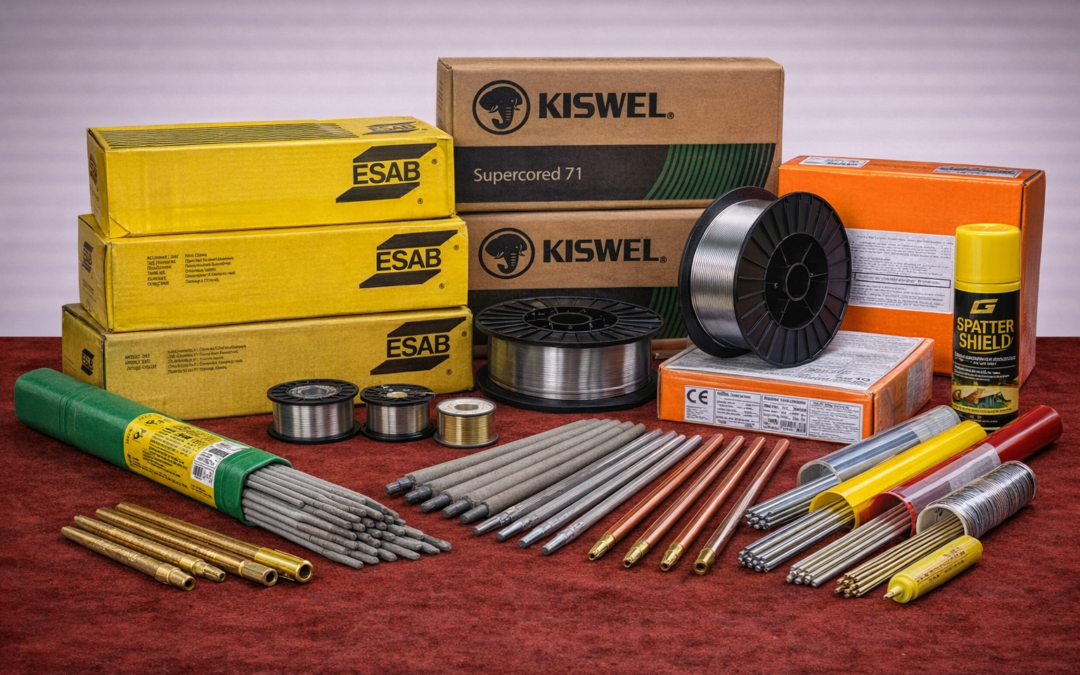
Ruby General Trading LLC’s Welding Equipment & Accessories category lists welding consumables including E6013 and E7018 electrodes, MIG welding wire, TIG filler rods, flux-cored wire, brazing rods and soldering rods. The range also includes welding machines, electrode holders, cables, torches, spare parts and related accessories.
For a wider project requirement, buyers can review Ruby’s welding equipment and accessories guide, safety equipment and PPE range and abrasives and polishing materials for associated workshop and fabrication needs. Confirm the exact classification, brand, size, documentation and availability against the project specification before placing an order.
Need a quotation for welding electrodes in Abu Dhabi or elsewhere in the UAE? Send Ruby your BOQ, WPS consumable requirement, electrode classification, diameter, brand preference and quantity. Contact the team at info@rubytrdg.com or +971 50 138 7277, or use the Ruby contact page. Ruby’s contact details list its Musaffah 26, Abu Dhabi location.
Frequently Asked Questions
What is the main difference between E6013 and E7018?
E6013 is a rutile-coated 60 ksi-class electrode commonly used for suitable general fabrication and maintenance. E7018 is a 70 ksi-class basic-coated low-hydrogen electrode used where its classification and handling requirements are specified by the approved procedure.
Is E7018 stronger than E6013?
E7018 has a higher minimum tensile-strength classification for deposited weld metal. That does not mean it is automatically suitable for every job; the electrode must match the base metal, joint design, required properties and WPS.
Can E6013 replace E7018?
No, not unless the responsible engineer, client and applicable procedure formally approve the substitution. If a drawing or WPS specifies E7018, use the specified consumable and required supplementary designators.
Can E6013 and E7018 both be used on AC machines?
Some products in both classifications support AC, but the required open-circuit voltage and current characteristics can differ. Check the exact product data sheet and the welding machine specification before use.
Why does E7018 need controlled storage?
E7018 is a low-hydrogen electrode. Moisture absorbed by the coating can affect diffusible-hydrogen performance and weld quality. Follow the manufacturer’s packaging, holding and reconditioning instructions and the approved WPS.
Which E6013 or E7018 diameter should I order?
Select the diameter from the WPS, joint design, material thickness, welding position and product data sheet. Do not choose a diameter only because it is commonly used in another workshop.
What details should be included in a welding electrode quotation request?
Provide the classification, brand or approved equivalent, diameter, length, quantity, application, WPS or project reference, required documentation and delivery location. Include storage or packaging requirements where applicable.