
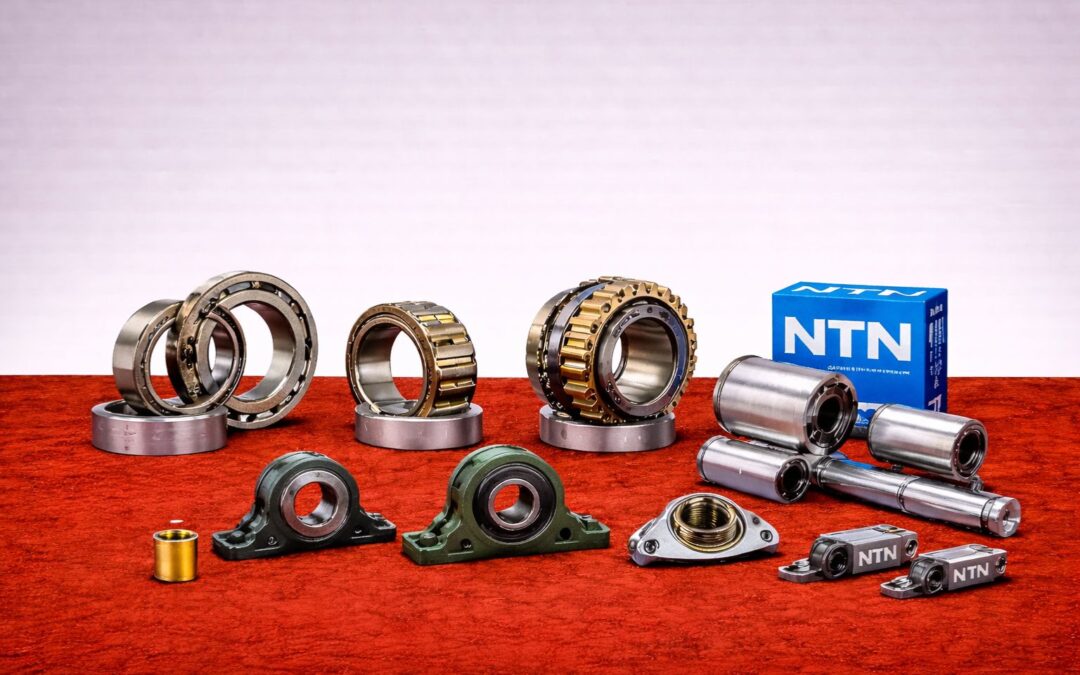
Pillow Block Bearings for Industrial Conveyors: Selection, Mounting and Maintenance
Pillow block bearings support rotating shafts in machinery where a bearing unit must be mounted onto a machine frame, base or support structure. They are common in conveyor systems, material-handling equipment, fans, agricultural machinery and general industrial drives. Choosing the correct unit involves more than matching the shaft diameter: the housing arrangement, locking method, load, speed, sealing, lubrication and mounting surface all influence service life.
For maintenance engineers, MRO buyers, plant operators and procurement teams in Abu Dhabi and across the UAE, this guide explains the main pillow block configurations, the information needed to specify a replacement, and the installation checks that help prevent early bearing failure. Ruby General Trading LLC lists ball, roller, spherical, thrust and pillow block/plummer block bearings in its mechanical power transmission range. Confirm the exact series, dimensions, manufacturer and availability against the machine requirement before ordering.
1. What Is a Pillow Block Bearing?
A pillow block bearing is a mounted bearing arrangement that supports a rotating shaft from a base or pedestal. In a common insert-style unit, a rolling bearing is fitted into a housing. The housing is then bolted to a machine frame, while the bearing’s inner ring is secured to the shaft using the locking method supplied with that design.
The term is also used alongside plummer block. In everyday purchasing, the terms can overlap, but product catalogues may distinguish a compact mounted insert unit from a larger split plummer-block housing that accepts a separate bearing. Always identify the complete assembly shown in the manufacturer’s catalogue rather than relying on the name alone.
Typical applications include:
- Conveyor rollers and material-handling shafts
- Packaging, processing and production-line equipment
- Fans, blowers and selected agricultural machinery
- Industrial machinery with externally supported rotating shafts
- Maintenance replacements where the existing housing and shaft arrangement are retained
2. Common Pillow Block and Mounted-Bearing Configurations
Mounted bearing units are available in different housing shapes to suit the way a shaft is supported. The following descriptions are common industry conventions; exact designations, dimensions and mounting details vary by manufacturer and series.
| Common configuration | Typical mounting arrangement | What to verify |
|---|---|---|
| Pedestal / pillow block (often UCP) | Base-mounted housing, commonly with two fixing holes | Bore, centre height, base length, bolt centres and locking style |
| Square flange (often UCF) | Flange-mounted housing, commonly with four fixing holes | Flange dimensions, hole pattern, shaft centre position and clearance |
| Oval / two-bolt flange (often UCFL) | Compact flange mounting on a side plate or frame | Hole spacing, flange orientation, housing clearance and load direction |
| Take-up unit (often UCT) | Slides in a frame or guide to adjust shaft position | Guide dimensions, adjustment travel, alignment and locking arrangement |
| Split plummer-block housing | Two-piece housing with a separately specified bearing and accessories | Housing series, bearing designation, seals, sleeves and locating arrangement |
Do not order a UCP, UCF or UCFL unit from the letters alone. Match the complete manufacturer’s designation and dimensions. Similar-looking housings can differ in bore, centre height, bolt spacing, insert design and permitted operating conditions.
3. How to Select the Correct Pillow Block Bearing
Confirm the shaft diameter and bearing bore
Measure the shaft at the bearing seat with a suitable calibrated measuring tool and compare it with the original bearing marking or machine drawing. Confirm whether the unit uses a straight bore, an adapter sleeve or another mounting arrangement. A loose or incorrectly sized shaft fit can allow the inner ring to creep, damage the shaft seat and generate heat.
Check the load and operating speed
Identify the radial load acting perpendicular to the shaft and any axial load acting along it. Record the shaft speed in revolutions per minute (rpm), starting frequency, shock loads and duty cycle. Many insert-style mounted units are primarily intended for radial support; permissible axial load and combined-load capability depend on the specific bearing design. Use the manufacturer’s rating and application guidance rather than assuming that every pillow block can handle the same load.
Choose the locking method for the shaft
Common insert-bearing arrangements include set-screw locking, eccentric locking collars and adapter sleeves. Each has its own installation sequence and suitability. The choice depends on shaft dimensions, operating direction, vibration, load, speed and the manufacturer’s instructions. Do not mix a locking collar from one design with an insert from another or tighten screws beyond the specified torque.
Match the seal to the environment
Dust, water spray, washdown, abrasive particles and process contamination can shorten bearing life. Review the available seal design, end cover and housing arrangement for the actual environment. A standard contact seal, a multi-lip arrangement and a labyrinth-style solution do not provide identical protection or friction characteristics. Check the manufacturer’s stated limits and do not treat an IP rating for a nearby motor or enclosure as a bearing seal rating.
Consider housing material and mounting strength
Cast-iron housings are common in general industrial applications. Pressed-steel, stainless-steel or polymer housings may be offered for particular weight, corrosion or hygiene requirements. These are not automatically interchangeable: confirm load capacity, stiffness, temperature range, chemical compatibility, fastener requirements and the mounting surface. The support structure must be rigid enough to carry the operating loads without twisting the housing.
4. Lubrication: Sealed, Pre-Greased or Relubricatable?
Some mounted units are supplied pre-greased for their intended service conditions; others include a grease nipple or lubrication passage for periodic relubrication. Do not assume that every unit needs the same grease or maintenance interval. The correct grease, quantity and interval depend on bearing design, speed, load, temperature, contamination and the manufacturer’s instructions.
- Check whether the unit is sealed for life or designed for relubrication.
- Confirm the grease specification and compatibility before adding a different product.
- Use the recommended quantity; over-greasing can cause churning, heat and seal damage.
- Keep grease nipples and surrounding surfaces clean before connecting a grease gun.
- Record lubrication dates, operating hours, temperature and any abnormal noise or vibration.
Ruby’s industrial lubricants range lists multipurpose, lithium, high-temperature and marine greases. Select a lubricant only after checking the bearing manufacturer’s compatibility and operating requirements; a product category description alone is not a technical approval for a specific bearing.
5. Installation Checks That Help Prevent Premature Failure
Incorrect installation can damage a new unit before it enters normal service. NTN’s bearing-unit guidance highlights the importance of a rigid, flat mounting face, correct seating and avoiding excessive tightening that can deform the housing. Use the current instructions for the exact bearing series.
- Isolate the machine: apply the site’s lockout/tagout procedure, stop all movement and verify that stored energy cannot restart the equipment.
- Inspect the shaft: clean the bearing seat and check for burrs, corrosion, scoring, wear, incorrect diameter and runout.
- Inspect the support: remove dirt, paint build-up and burrs. Check that the mounting face is rigid, flat and free from distortion.
- Position both supports: align the housings with the shaft and machine arrangement. Do not use the mounting bolts to pull a misaligned shaft into position.
- Secure the housing: use the specified fasteners, washers and tightening torque. Follow the manufacturer’s sequence and avoid distorting the housing.
- Lock the bearing to the shaft: apply the correct set-screw, eccentric-collar or adapter-sleeve procedure for the exact unit.
- Check the assembly: rotate the shaft by hand where safe and permitted, confirm free movement and check guards, seals and lubrication arrangements before commissioning.
- Monitor start-up: observe noise, vibration and temperature against the equipment’s normal baseline. Stop and investigate abnormal conditions rather than allowing the unit to run in a damaged state.
Never transmit fitting force through the rolling elements by striking the bearing or housing. Use the appropriate mounting tools and manufacturer-approved procedure. For larger or heavier units, plan safe lifting and handling. See NTN’s handling guidance for bearing units and SKF’s mounted-unit mounting and dismounting instructions.
6. Common Causes of Pillow Block Bearing Problems
| Observed issue | Possible contributors | Useful checks |
|---|---|---|
| Overheating | Excess grease, wrong lubricant, excessive load, poor fit or misalignment | Temperature trend, grease condition, shaft fit and alignment |
| Vibration or noise | Worn bearing, contamination, looseness, damaged shaft or imbalance | Vibration data, fasteners, shaft runout and rotating equipment condition |
| Inner-ring movement | Incorrect locking procedure, worn shaft seat or wrong bore | Shaft diameter, locking device and specified tightening torque |
| Repeated seal damage | Contamination, wrong seal type, shaft surface damage or excess heat | Seal condition, environment, shaft finish and operating temperature |
| Housing movement | Weak or uneven base, loose fasteners or incorrect mounting | Base rigidity, flatness, bolt condition and mounting dimensions |
These symptoms are diagnostic clues, not proof of a single failure cause. Review the complete machine, lubrication records and operating conditions before replacing parts. If the same unit fails repeatedly, investigate the shaft, support frame, alignment, load and contamination rather than simply fitting another bearing.
7. What to Include in a Pillow Block Bearing RFQ or BOQ
A complete enquiry helps the supplier identify the correct unit and reduces avoidable substitutions. Include as many of the following details as possible:
- Existing bearing number, manufacturer, series and a clear photograph of the marking
- Housing configuration and complete unit designation, if known
- Shaft diameter, bore type and any adapter sleeve or locking arrangement
- Housing dimensions, centre height, bolt-hole centres and mounting orientation
- Radial and axial load information, shaft speed and duty cycle
- Operating temperature, dust, water, washdown, chemical or corrosion exposure
- Seal type, end cover and whether the unit is sealed or relubricatable
- Required quantity, preferred manufacturer or approved equivalent, documentation and delivery location
If the part number is unreadable, provide measurements and photographs of the unit, shaft seat and mounting base. Do not rely on a visual match alone. Confirm dimensions and ratings against the manufacturer’s catalogue before approving a replacement.
8. Industrial Bearing and Maintenance Supply from Ruby General Trading
Ruby General Trading LLC’s mechanical power transmission page lists ball bearings, tapered and cylindrical roller bearings, spherical and thrust bearings, pillow block/plummer blocks, flange bearings and linear bearings. The same range includes belts, pulleys, chains, couplings, gearboxes, motors, bushings, shafts and conveyor components.
For maintenance teams coordinating rotating equipment, Ruby also lists pneumatic and hydraulic equipment and industrial hoses and fittings. These are related procurement categories, not substitutes for the correct bearing specification.
Need a pillow block bearing or replacement mounted unit? Send Ruby the bearing number, shaft diameter, housing type, quantity and application, together with a photograph or equipment drawing if available. Request a quotation through the Ruby contact page, email info@rubytrdg.com or call +971 50 138 7277. Ruby’s listed Abu Dhabi address is Musaffah 26, near Nesto, Abu Dhabi, UAE. Confirm exact product availability and delivery arrangements with the team.
Frequently Asked Questions
What is the difference between a pillow block and a plummer block?
The terms are sometimes used interchangeably for mounted shaft-support arrangements. Some catalogues distinguish compact insert-bearing units from larger split plummer-block housings that use a separately specified bearing. Follow the exact manufacturer’s product designation.
What is the difference between UCP, UCF and UCFL bearing units?
In common product nomenclature, UCP usually refers to a pedestal-mounted unit, UCF to a square four-bolt flange unit and UCFL to an oval two-bolt flange unit. Confirm the dimensions and series with the relevant manufacturer because designations can vary.
Can a pillow block bearing accommodate shaft misalignment?
Some insert-bearing designs have a spherical outside surface that allows limited alignment within the unit’s specified range. This does not compensate for a bent shaft, an unstable base or incorrect support positioning. Check the manufacturer’s permissible alignment limits.
How do I identify the correct replacement pillow block?
Start with the complete part number. If it is unavailable, record the shaft diameter, housing type, bolt centres, centre height, locking method, seal arrangement and operating conditions. A photograph helps but should be checked against measured dimensions.
Do pillow block bearings need regular greasing?
It depends on the design. Some units are pre-greased and sealed, while others are relubricatable. Use the manufacturer’s specified grease, quantity and interval for the actual speed, load, temperature and environment.
Why does a new pillow block bearing become hot?
Possible causes include incorrect installation, excessive grease, wrong shaft fit, misalignment, excessive load, contamination or a damaged bearing. Stop and investigate abnormal temperature rather than assuming the unit needs more grease.
Can I replace only the bearing insert instead of the complete unit?
Some mounted units have replaceable inserts, but compatibility depends on the housing, insert profile, locking arrangement, dimensions and manufacturer. Confirm the exact replacement procedure and approved insert before ordering.