LED High Bay Lights for Warehouses: How to Choose the Right Fixture
LED high bay lights are designed for large indoor spaces where luminaires are mounted well above the working floor. Warehouses, distribution centres, workshops, production halls and logistics facilities need more than a bright fitting: they need suitable light levels across aisles and work areas, controlled glare, dependable operation and a layout that fits the building. Choosing only by wattage or the appearance of a fixture can leave dark zones, wasted energy or costly maintenance problems.
For facility managers, MEP contractors, warehouse operators and procurement teams in Abu Dhabi and across the UAE, this guide explains how to specify high bay lighting, compare fixture styles, review the technical data and prepare a useful request for quotation (RFQ). Ruby General Trading LLC’s Electrical & Lighting range lists high bay, low bay and linear industrial lights; exact model specifications and availability should be confirmed against the project requirement.
1. What Are LED High Bay Lights?
A high bay luminaire is an industrial or commercial light fitting intended for installation in a space with a relatively high ceiling. It directs useful light down to the floor, storage aisles, production lines or workstations from a higher mounting position. The term is used for a type of application rather than one universal ceiling-height threshold; the appropriate fixture and optical distribution depend on the actual room and visual task.
Typical applications include:
- Distribution centres, storage warehouses and logistics facilities
- Manufacturing plants, assembly areas and industrial workshops
- Maintenance bays, equipment rooms and fabrication areas
- Sports halls, exhibition spaces and large retail back-of-house areas
- Loading and dispatch zones where indoor lighting is required
High bay lighting is not a substitute for a complete lighting design. Racking, cranes, machinery, mezzanines, roof structure, daylight and the work being performed all affect the amount and distribution of light required.
2. UFO vs Linear High Bay Fixtures
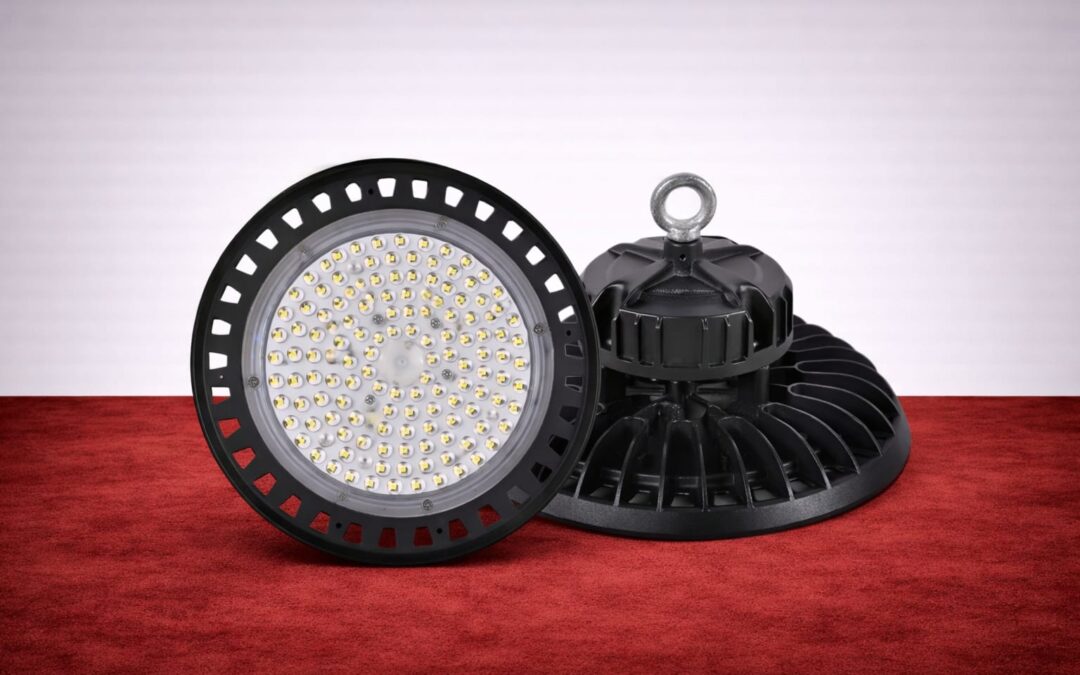
Two common high bay formats are round UFO-style fittings and linear high bay luminaires. Neither is automatically better for every warehouse. The choice should follow the room geometry, racking arrangement, mounting positions and photometric data.
| Fixture type | Typical application | What to check |
|---|---|---|
| UFO / round high bay | Open warehouse floors, workshops and broad industrial spaces | Beam distribution, glare, mounting method and spacing |
| Linear high bay | Long production lines, aisles and spaces with elongated work zones | Optics, orientation, aisle width and continuity of illumination |
| Low bay luminaire | Lower mounting heights where a high bay distribution may not be suitable | Actual mounting height, light distribution and glare control |
For narrow racking aisles, a fixture with an appropriate aisle optic may direct more light onto the vertical storage faces and floor than a wide, symmetrical distribution. In an open workshop, a broad distribution may be more appropriate. Ask for the photometric file and proposed layout rather than selecting by product shape alone.
3. Start with the Required Light Level, Not the Wattage
Wattage tells you how much electrical power a fitting consumes. It does not tell you how much light reaches a particular shelf, workbench or floor area. Compare luminaires using their verified luminous flux, measured in lumens, and their luminous efficacy, measured in lumens per watt (lm/W). Then check the photometric distribution to understand where that light goes.
Before selecting a fitting, define the maintained illuminance required for each task area. Illuminance is measured in lux (lumens per square metre). A general storage aisle, a picking station, a quality-inspection bench and a detailed assembly task may require different lighting conditions. The required values should come from the project’s applicable lighting standard, consultant specification and task assessment—not a generic wattage chart.
For indoor workplaces, EN 12464-1:2021 addresses lighting quantity and quality, including maintained illuminance, uniformity and glare. It is a design reference, not a substitute for checking the codes and authority requirements applicable to a UAE project. See the BSI overview of BS EN 12464-1.
4. Key Technical Specifications to Compare
Lumen output and efficacy
Compare the complete luminaire’s rated lumen output, not just the LED chip rating. Check the test conditions and supporting photometric report. A higher lm/W figure can indicate more light per watt, but it does not prove that the fitting will deliver the required lux or uniformity in your building.
Beam angle and optical distribution
Beam angle affects how light spreads from the fitting. A broad distribution may suit open floors, while a narrower or asymmetric distribution may be useful for tall or narrow aisles. The right choice depends on mounting height, fitting spacing, aisle geometry and reflectance. Do not use beam angle as the only design measure; review the full intensity distribution or IES/LDT photometric file.
Colour temperature and colour rendering
Correlated colour temperature (CCT), expressed in kelvin (K), describes whether light appears warmer or cooler. The selected CCT should suit the workplace, operator preference and project specification. Colour rendering index (CRI or Ra) describes how accurately colours appear under the light source. Higher colour fidelity can matter for inspection, sorting, colour matching and quality-control tasks. Confirm the required CRI and CCT in the approved submittal.
Glare and visual comfort
A very bright fitting can still create an uncomfortable environment if the LED source is exposed or the optical design is unsuitable. Review glare data where provided, diffuser or lens design, mounting position and viewing angles. Consider operators looking upward at cranes, elevated equipment or tall racks, as well as people working at benches below the fittings.
Ingress protection and impact resistance
Check the luminaire’s IP rating against dust, moisture and cleaning exposure. IEC 60529 defines the IP Code used to classify protection provided by electrical enclosures. An IP rating should be supported by the product’s test documentation; it does not by itself establish suitability for every chemical, corrosive atmosphere or washdown process. Where impact resistance matters, check the separate IK rating and the actual test evidence.
Operating temperature and electrical characteristics
Industrial roofs can become hot, especially in the UAE. Confirm the manufacturer’s rated ambient temperature range (Ta), driver temperature limits, voltage and frequency, power factor, surge protection, dimming compatibility and any stated thermal derating. A luminaire that is suitable for a cool indoor room may not be appropriate near a hot roof deck or process equipment.
5. Plan the Layout Around Racking, Machines and Work Tasks
Fixture count and spacing should be determined through a lighting calculation. A practical design workflow is:
- Collect the building details: record floor dimensions, mounting height, roof structure, racking heights, aisle widths, cranes, machinery and existing fittings.
- Map the work areas: distinguish storage, picking, packing, inspection, production, maintenance, walkways and loading zones.
- Set the design criteria: confirm maintained lux, uniformity, glare limits, colour quality and any client or authority requirements for each task.
- Review photometric data: use the actual luminaire IES or LDT file in suitable lighting-design software, with realistic surface reflectances and obstructions.
- Check maintenance assumptions: include a maintenance factor based on the environment, cleaning plan, luminaire data and expected lumen depreciation.
- Verify after installation: measure illuminance at the specified grid points, check uniformity and correct any dark or excessively bright areas.
Do not copy a spacing rule from another warehouse without checking the dimensions and optics. Tall racking can block light from reaching lower shelves; a crane runway can create shadows; glossy floors or packaging can produce reflections. The design should consider vertical as well as horizontal illuminance when the task requires workers to read labels or identify goods on shelving.
6. Energy Use, Controls and Maintenance
When replacing older metal-halide or fluorescent fittings, compare the existing installation with the proposed LED design on a like-for-like basis. Record the number of fittings, actual input watts, operating hours, control arrangements, light levels and maintenance costs. A simple payback estimate should use the site’s electricity tariff and realistic operating hours; do not rely on a supplier’s generic savings percentage.
Occupancy sensors, daylight-responsive dimming and scheduled controls can reduce operating hours or output where the task and safety requirements permit. Check sensor coverage, response time, minimum dimming level and compatibility with the LED driver. Emergency lighting and exit-sign circuits must be designed and maintained separately in accordance with the applicable requirements.
LED products can retain useful light output for many years, but life claims need careful interpretation. The U.S. Department of Energy explains that LED useful life is often expressed as the time until light output falls to a defined proportion of initial output, and that driver or electronic components can fail independently. Review the manufacturer’s lumen-maintenance data, warranty conditions and driver-replacement arrangements. See the DOE LED basics and reliability guidance.
7. Installation and Workplace Safety
High bay fittings are installed at height, so the work plan must address electrical isolation, access equipment, falling objects and safe lifting. Installation should be carried out by competent personnel using the mounting hardware and method approved by the luminaire manufacturer. Confirm that the roof structure or support system is suitable for the fitting and that suspension points, hooks, chains or brackets are correctly rated and secured.
- Isolate and verify the electrical supply before installation or maintenance.
- Use approved access platforms and fall-protection arrangements for the task.
- Protect workers and stored goods below the installation area from falling tools or components.
- Check cable entry, earthing, terminal torque, driver enclosure and mounting security against the instructions.
- Keep emergency routes, exit signs and emergency lighting unobstructed and operational.
- Record commissioning readings and retain datasheets, test reports and maintenance instructions.
OSHA’s U.S. construction rule 29 CFR 1926.56 lists minimum illumination levels for specified construction areas, shops and indoor warehouses. It is a useful reference for understanding the relationship between work area and light level, but it is not UAE law; follow the applicable UAE legislation, authority requirements and project specifications. Read OSHA’s illumination rule.
8. Common High Bay Lighting Procurement Mistakes
- Choosing the highest wattage instead of calculating the required light distribution.
- Comparing LED chip lumens rather than complete-luminaire output and photometric data.
- Ignoring rack height, aisle width, cranes, mezzanines and machine shadows.
- Accepting an IP rating without checking the test standard, product certificate and application.
- Overlooking ambient temperature, surge exposure, driver quality or dimming compatibility.
- Using a generic fixture-spacing recommendation without a project-specific layout.
- Failing to specify emergency lighting, controls, mounting accessories or commissioning separately.
- Comparing purchase price alone without considering energy use, maintenance access and warranty terms.
9. What to Include in a High Bay Lighting RFQ or BOQ
Send the supplier enough information to identify a suitable product and avoid assumptions. Include:
- Project location and application: warehouse, factory, workshop, logistics centre or other space.
- Floor plan, ceiling or mounting height, racking layout and aisle dimensions.
- Required maintained lux, uniformity and glare criteria from the project specification.
- Fixture format preference, if already defined: UFO, linear or aisle optic.
- Required lumen output, efficacy, CCT, CRI and beam distribution, if specified.
- IP and IK requirements, ambient temperature, humidity, dust and cleaning exposure.
- Input voltage, frequency, power factor, surge protection and control/dimming requirements.
- Mounting method, quantity, accessories, emergency-lighting interface and installation scope.
- Required datasheets, IES/LDT files, certificates, warranty, delivery schedule and approved-brand list.
For a retrofit, attach photographs of existing fittings and nameplates, the current fixture count and wattage, measured light levels if available, and details of the proposed operating hours. Ask for a layout or photometric calculation before approving a large order.
10. Industrial Lighting Supplies from Ruby General Trading
Ruby General Trading LLC’s Electrical & Lighting range lists high bay lights, low bay lights, linear industrial lights, explosion-proof lights, emergency lights and exit signs, alongside LED drivers, cables, switches and electrical accessories. Buyers can also review the related cable tray systems guide and cable glands selection guide when planning the wider electrical installation.
Product-specific wattage, lumen output, CCT, CRI, IP/IK rating, photometric files, warranty and availability must be confirmed for the selected model. Ruby’s team is based in Musaffah 26, Abu Dhabi, and its website states that it supplies customers across Abu Dhabi and the UAE.
Planning a warehouse or industrial lighting project? Send your BOQ, floor plan, mounting height, racking layout and lighting specification for a quotation enquiry. Contact Ruby at info@rubytrdg.com or call +971 50 138 7277. You can also use the Ruby contact page.
Frequently Asked Questions
What is the difference between high bay and low bay lights?
High bay luminaires are designed for higher mounting positions and larger indoor spaces, while low bay fittings are intended for lower mounting heights. There is no single height threshold that determines the correct fitting in every project; optics, ceiling geometry and task requirements matter.
How many LED high bay lights does a warehouse need?
The quantity depends on the floor area, mounting height, racking, required maintained lux, luminaire output, beam distribution and uniformity target. A project-specific photometric calculation is more reliable than a simple square-metre rule.
Is a higher-wattage high bay always brighter?
Not necessarily. Wattage measures electrical input. Compare verified luminaire lumens, efficacy and photometric distribution, then assess the illuminance delivered to the task area.
What IP rating should a warehouse high bay light have?
Choose the rating according to dust, moisture, cleaning and environmental exposure. Confirm the exact enclosure rating and test documentation. An IP rating alone does not prove suitability for corrosive chemicals or every washdown condition.
Are UFO high bay lights better than linear high bays?
Neither format is universally better. UFO fixtures can suit open floor areas, while linear or aisle optics may suit long production lines and racking aisles. The photometric layout should decide.
What information should I send for a high bay lighting quotation?
Provide a floor plan, mounting height, aisle and rack dimensions, task areas, required lux, environmental conditions, electrical supply, controls, quantities and any approved-brand or certification requirements.
Do LED high bay lights need maintenance?
Yes. Clean lenses and heat-sink surfaces as permitted by the manufacturer, inspect mounting and electrical connections, monitor driver performance and periodically measure light levels. Follow the product’s maintenance and warranty instructions.